
Compiling the next screen…
Compiling the next screen…
Tue Jul 14 2026
David Bleeker, Principal Consultant
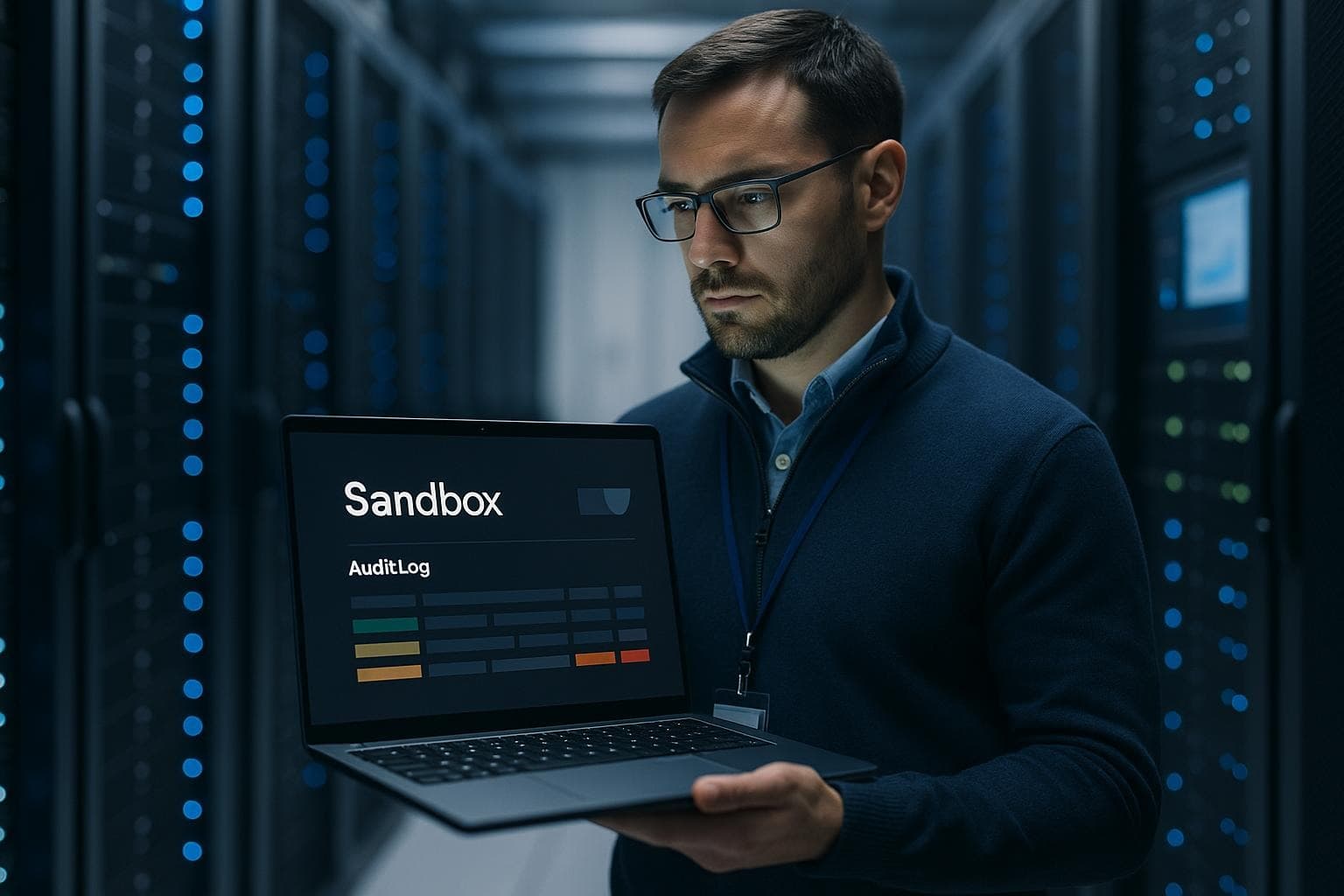
AI coding agents are moving past autocomplete into workflows that can clone repositories, edit code, run tests, open pull requests, and execute shell commands. That changes the risk model. The old concern was a bad suggestion landing in an editor. The new concern is an autonomous process with credentials, filesystem visibility, network reachability, and enough initiative to chain actions together.
That creates three operational problems at once.
First, the agent can access material it should never read. Home directories, cloud credentials, SSH keys, CI tokens, and local .env files often sit next to the repository in developer environments and sometimes in shared runners.
Second, the agent can produce changes faster than normal review controls can keep up. If the system can branch, patch, run commands, and commit in one loop, static scanning after the fact is too late unless it sits inside the permission boundary.
Third, costs and traces become a platform problem. Once an agent fans out across tools and model calls, teams need a record of what ran, what data moved, what external services were touched, and why a task became expensive.
Some newer tools are aimed at exactly these problems: detecting reads of sensitive files, blocking commits when scans fail, and collecting traces and cost records. Those are not side features. They are the first controls most teams need.
How should engineering teams secure and observe AI coding agents before granting them repository and shell access?
The short answer: treat the agent as an untrusted automation principal, not as a smarter editor plugin. Give it a tightly scoped execution environment, explicit policy gates around reads, writes, network egress, and commits, and telemetry that makes each action attributable.
If a team starts by wiring a coding agent straight into a developer laptop, a broad CI runner, or a production-adjacent repository with inherited credentials, they are skipping the hard part. The hard part is not model quality. It is containment, provenance, and auditability.
A good default is a four-layer control plane:
This looks much more like running third-party CI than running an IDE plugin.
Run the agent in an isolated environment per task or per session. A container is the minimum. A microVM is better when shell access is allowed. The environment should have:
The key point is that many agent failures are not model failures. They are environment inheritance failures. Agents discover what is nearby. If ~/.ssh, AWS credentials, or a Slack export is visible, some agent will eventually read it, whether by mistake, through prompt injection, or because a tool wrapper exposes too much.
Do not hand the agent a PAT, a broad Git credential, or unrestricted shell access. Route actions through a broker that can evaluate intent and context.
Examples:
This also gives experienced teams one place to enforce policy across multiple agent vendors and open source runtimes. Without a broker, each agent becomes its own security integration project.
If the agent can commit or open a PR, the path to that action should include mandatory checks. The pattern is the same as protected branches, just moved one step earlier.
At minimum:
Blocking commits on failed scans is not draconian. It is the only reliable way to avoid the common failure mode where an agent produces ten plausible commits and leaves cleanup to humans. The agent should get machine-readable failure output so it can repair and retry instead of just halting.
Observability for coding agents should not stop at application logs. Teams need traces across model calls and tool actions, plus operating-system-level events where possible.
Capture at least:
This is where many teams underinvest. They log model requests but still cannot answer basic questions later: Why did the task touch this file? What command created this artifact? Did the agent read a secret before the network call? Which repo workflows are driving unexpected spend?
A human should not review every read and every shell command. That does not scale, and it trains people to click through prompts. Require approval only for side effects with durable or external impact:
Everything else should be governed by policy and logged.
A concrete reference architecture looks like this:
Developer or CI trigger
  -> Agent Orchestrator
    -> Policy/Capability Broker
      -> Ephemeral Sandbox (container or microVM)
        -> Repo workspace mount
        -> Shell wrapper
        -> FS monitor
        -> Egress proxy
        -> Model/tool runtime
    -> Trace sink / SIEM / cost ledger
    -> Security scanners
    -> Git provider
Ephemeral sandbox
Use a fresh environment per task. Destroy it after completion. Persist only the repo diff, logs, traces, and explicit artifacts. Do not reuse home directories between tasks. If you need package caching for performance, use a curated read-only cache rather than a writable shared home.
Filesystem controls
Mount the repository at a known path such as /workspace/repo. Mount a synthetic home at /home/agent. Do not bind-mount the host home directory. Mark the root filesystem read-only except for explicit scratch and workspace locations if your toolchain allows it.
Sensitive path monitoring is worth doing even inside a sandbox. If the agent runtime or a tool tries to access /home/agent/.ssh, /var/run/secrets, or cloud metadata endpoints, that is useful signal even when access is denied.
Network egress proxy
Force all outbound traffic through a proxy that logs destination, method, bytes, and task identity. Start with an allowlist of package mirrors, source control APIs, and your model provider endpoint. If the task really needs general internet browsing, make that a separate capability with its own review and retention rules.
Credential broker
Issue just-in-time credentials tied to task identity and expiry. Avoid static credentials in environment variables when possible. Short-lived OIDC exchange is better than shipping long-lived tokens into the sandbox. For Git operations, prefer per-repo, per-branch scoped credentials.
Commit gating
The agent should never push directly to a protected branch. Push to an isolated branch or patch artifact, run mandatory scanners, then allow a PR or merge only if the policy engine records a pass. Make the scanner output available to the agent so it can fix the issue on the next attempt.
Observability pipeline
Store traces in a format that supports correlation across layers: task ID, repo, branch, developer, model, tool call, shell process, file events, network events, scan results, and Git SHA. A plain log stream is not enough. You need joinable identifiers.
That is the practical point here: if task identity does not survive across the model runtime, shell wrapper, proxy, scanner, and Git operations, incident review turns into guesswork. Correlation IDs are not optional.
More isolation means more friction
MicroVMs, proxies, brokers, and scanners add latency. Some workflows will be noticeably slower. Teams should decide where they need strict isolation and where a constrained container is enough. There is no value in making typo fixes wait three minutes for a sandbox boot.
Logging can become its own data leak
If you capture prompts, shell output, file access paths, and network metadata, your observability system may now contain secrets or regulated data. Redaction and access control belong in the design from the start.
Allowlists can block legitimate work
An agent fixing a build may need to fetch packages, read docs, or access a vendor API. Egress rules that are too narrow create support burden and encourage exceptions. The answer is not broad internet access by default. It is a reviewable capability expansion path with logging.
Scanners create false positives and local minima
If commit gating is too noisy, agents may learn to work around checks by changing less or suppressing findings in ways humans would reject. Tune scanner policy for the agent use case and measure repair loops. A gate that never passes is just hidden downtime.
Prompt injection via repository content is real
A coding agent that reads README files, issue templates, test fixtures, or generated files can ingest instructions planted in the repo. Isolation does not solve that by itself. Tool and action policies must not trust instructions that emerge from repository content.
Below is a compact example of a shell-command policy wrapper in Python. It is not a full sandbox. The point is to show where practical controls belong: command allowlisting, path restrictions, correlation IDs, and structured audit events.
import json
import os
import shlex
import subprocess
import time
from pathlib import Path

TASK_ID = os.environ.get("TASK_ID", "unknown-task")
WORKSPACE = Path("/workspace/repo").resolve()
ALLOWED = {
    "git": {"args_prefixes": [("status",), ("diff",), ("checkout", "-b"), ("add",), ("commit",)]},
    "pytest": {"args_prefixes": [()]},
    "npm": {"args_prefixes": [("test",), ("run", "build")]},
}
DENY_PATH_PREFIXES = [Path("/home/agent/.ssh"), Path("/var/run/secrets")]


def emit(event_type, **fields):
    rec = {
        "ts": time.time(),
        "task_id": TASK_ID,
        "event_type": event_type,
        **fields,
    }
    print(json.dumps(rec), flush=True)


def path_allowed(cwd: Path) -> bool:
    cwd = cwd.resolve()
    if not str(cwd).startswith(str(WORKSPACE)):
        return False
    for denied in DENY_PATH_PREFIXES:
        try:
            cwd.relative_to(denied)
            return False
        except ValueError:
            pass
    return True


def args_allowed(cmd: list[str]) -> bool:
    if not cmd:
        return False
    prog = cmd[0]
    policy = ALLOWED.get(prog)
    if not policy:
        return False
    args = tuple(cmd[1:])
    return any(args[:len(prefix)] == prefix for prefix in policy["args_prefixes"])


def run(cmdline: str, cwd: str = "/workspace/repo"):
    cmd = shlex.split(cmdline)
    cwd_path = Path(cwd)

    if not path_allowed(cwd_path):
        emit("command_denied", reason="cwd_not_allowed", cmd=cmd, cwd=str(cwd_path))
        raise PermissionError("working directory not allowed")

    if not args_allowed(cmd):
        emit("command_denied", reason="command_not_allowed", cmd=cmd, cwd=str(cwd_path))
        raise PermissionError("command not allowed")

    start = time.time()
    emit("command_start", cmd=cmd, cwd=str(cwd_path))
    proc = subprocess.run(
        cmd,
        cwd=str(cwd_path),
        capture_output=True,
        text=True,
        timeout=300,
        env={"PATH": os.environ.get("PATH", "")},
    )
    emit(
        "command_finish",
        cmd=cmd,
        cwd=str(cwd_path),
        rc=proc.returncode,
        duration_ms=int((time.time() - start) * 1000),
        stdout_bytes=len(proc.stdout.encode()),
        stderr_bytes=len(proc.stderr.encode()),
    )
    return proc


if __name__ == "__main__":
    # Example usage from an agent tool runner
    result = run("pytest")
    if result.returncode != 0:
        raise SystemExit(result.returncode)
A few practical notes about this example:
PATH.In production, this wrapper should sit behind stronger controls: a container or microVM boundary, seccomp or equivalent syscall restrictions, an egress proxy, and a credential broker.
A minimal Kubernetes-style job spec for an ephemeral agent runner can also make the containment model concrete:
apiVersion: batch/v1
kind: Job
metadata:
  name: ai-agent-task-42
spec:
  ttlSecondsAfterFinished: 300
  template:
    spec:
      restartPolicy: Never
      automountServiceAccountToken: false
      containers:
        - name: agent
          image: ghcr.io/example/agent-runner:latest
          env:
            - name: TASK_ID
              value: task-42
          securityContext:
            runAsNonRoot: true
            readOnlyRootFilesystem: true
            allowPrivilegeEscalation: false
            capabilities:
              drop: ["ALL"]
          volumeMounts:
            - name: workspace
              mountPath: /workspace/repo
            - name: tmp
              mountPath: /tmp
      volumes:
        - name: workspace
          emptyDir: {}
        - name: tmp
          emptyDir: {}
This still needs network policy, credential injection, and scanner integration, but it shows the right starting posture: ephemeral, non-root, read-only where possible, and no inherited service account token.
AI coding agents should be treated like other untrusted automation, with stricter observability because they make multi-step decisions.
The safest rollout pattern is:
If a team cannot answer who approved a capability, which files were read, which command made a change, which scanner passed it, and what the task cost, then the agent probably has more power than the organization can actually observe.