
Compiling the next screen…
Compiling the next screen…
Contentware is a marketing technology platform that turns a webinar landing page into a full multi-day campaign of social posts and emails. Cataluma served as lead architect and full-stack developer, building the React front end, the Apollo GraphQL API, and the OpenAI-based content generation pipeline — plus a human review step so a person signed off on every post before it went live. The platform integrated with major social, email, and billing platforms and ran in production for four years.
David is by far the best and most experienced developer I have worked with in my career. He consistently delivered high-quality code, demonstrating meticulous attention to detail and a commitment to writing clean, efficient, and scalable software. I look forward to working with David on future collaborations and would highly recommend him for any software development project.
Marketing teams run webinars — live online talks — to reach new customers. After each webinar, a team must turn it into days of social posts and emails. This work takes hours. It also needs a writer, a designer, and a manager to check each post before it goes live.
Contentware, a marketing technology startup, wanted to remove that manual work. The founder needed a platform that could read a webinar's landing page, write a full multi-day campaign from it, and let a human check and approve every piece before it went out.
Cataluma was the lead architect and full-stack developer for Contentware from 2020 to 2024, designing the system from the ground up and building most of it directly, with support from other engineers, a data scientist, and a cloud infrastructure specialist.
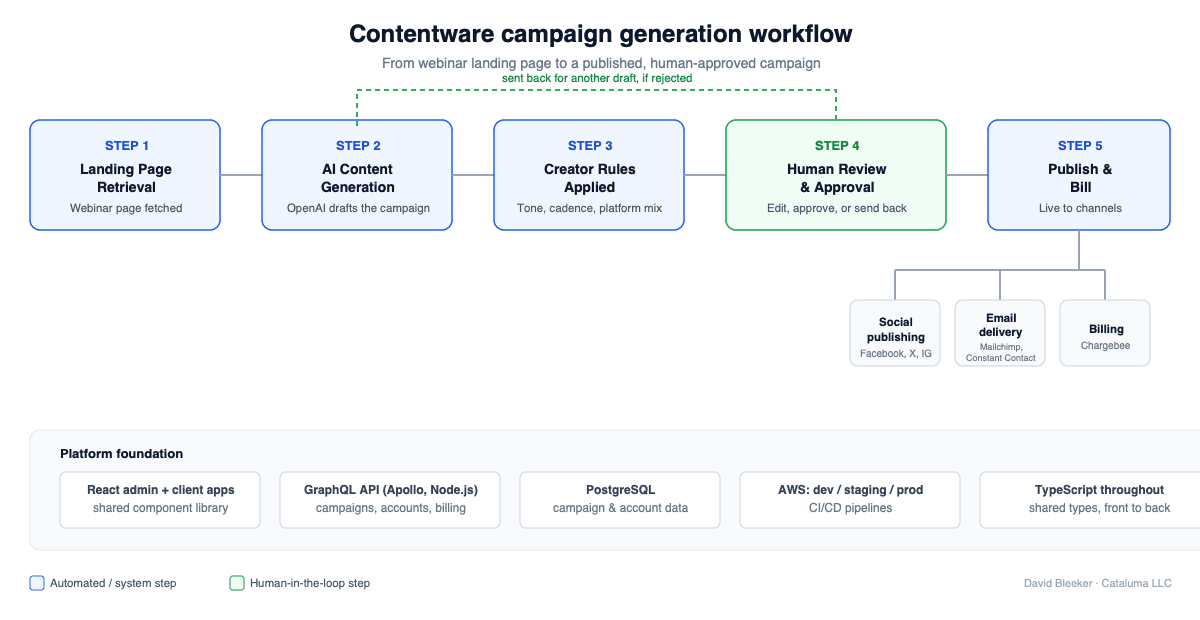
Application layer. Cataluma built the React admin app for the Contentware team and the React client app for paying customers. Both shared a component library and a design system. Both apps ran on a modular GraphQL API, built with Apollo GraphQL and Node.js. That API handled campaign creation, content review, approval, publishing, and billing. A dynamic campaign calendar showed the full timeline with previews that matched how each post would look on its target platform.
Content generation. The platform pulled text and images from a customer's webinar landing page. It sent that content to the OpenAI API to draft a multi-day campaign: a sequence of social posts and marketing emails. Cataluma built a custom templating language that let customers specify exactly what each post should say, so the AI drafted from a precise brief instead of a vague prompt. Each customer could also set campaign rules — tone, post count, platform mix, posting cadence — which shaped how the draft came out.
Human review. No AI draft published on its own. Every generated post and email went through a review screen. There, a customer or a Contentware team member could edit the text, approve it, or send it back for another draft. This human-in-the-loop step was central to the product. Customers trusted the output because they had the final say.
Data and integrations. Cataluma designed the PostgreSQL schema and API structure to handle campaign, account, billing, and integration data at speed. A customer could open a campaign and see every post's status without a slow page load. Cataluma integrated the platform with Facebook, Instagram, Twitter/X, and LinkedIn for publishing; Mailchimp, Constant Contact, HubSpot, Informz, Omeda, and ActiveCampaign for email and marketing automation; Hootsuite for social scheduling; and Chargebee for billing and subscriptions.
Infrastructure. Cataluma set up and maintained separate development, staging, and production environments on AWS. CI/CD pipelines made deploys safe and repeatable for a live product with paying customers.
I owned the architecture and wrote most of the application code. I also coordinated day-to-day work with two other engineers. A data scientist tuned the content generation prompts and rules. A cloud infrastructure specialist managed AWS. I worked directly with the founder to turn product goals into a technical plan, and I made the final call on architecture and delivery tradeoffs.
Contentware moved campaign creation from a manual, hours-long task into a deployed SaaS workflow with built-in review and approval. The platform ran in production for four years and served paying customers.
We're literally saving 5-7 hours for every campaign that we use Contentware.
One customer reported a 400%+ increase in engagement for their webinars after adopting Contentware-generated campaigns.
Work directly with Cataluma’s principal consultant on the next useful technical step.